Schulpforta's censorship of cadet correspondence
All the Light We Cannot SeeSchulpforta's censorship of cadet correspondence turns letters between Werner Pfennig and Jutta Pfennig into a communication channel that is both intimate and controlled. Jutta’s letters reach Werner with much of their content blacked out, and Werner knows that questions she asks are not safe to state openly. The school’s oversight therefore affects not only what the siblings can tell one another, but also what Werner dares to put on paper. Their correspondence preserves a bond across distance even as censorship makes that bond partial and guarded.
How the Censorship Appears
The most explicit account comes from Werner’s letter to Jutta. He says that the school censor blacks out her letters almost completely and describes her as asking questions that should not be asked. The extent of the redaction is significant: the surviving letters still arrive, but much of their message is unavailable to Werner and to the reader. Censorship operates through the physical interruption of correspondence, making the missing passages part of what the letters communicate about life at Schulpforta.
Werner’s own letters also contain marked omissions. In one, he tells Jutta about Dr. Hauptmann’s workshop, where he works on circuits for a radio under test, and about being set calculations in trigonometry. The account includes gaps marked as censored around what Dr. Hauptmann will not answer and around a description of the copper wire. Another letter recounts a field-exercise story about Reiner Schicker and notes that Frederick’s response to the story is censored. These visible breaks show that the material reaching the reader is incomplete; the omitted content cannot be recovered from the surviving text.
What the Letters Still Carry
Despite those omissions, the correspondence retains ordinary details of family life. Werner asks Jutta to tell Frau Elena that he is eating well, while adding that no one at school makes flour cakes like hers. He also asks her to look after little Siegfried and says that he thinks of her every day. In another letter, he asks whether Jutta’s cough has improved and mentions that Frau Elena has a cough too. These messages are not simply reports about school: they carry concern for people at home and give Werner a way to remain involved in the life he has left behind.
The letters also convey how different the siblings’ positions have become. Werner writes about his technical work for Dr. Hauptmann and about Frank Volkheimer, whose presence makes other boys treat Werner with respect. Yet these glimpses of privilege sit beside the erasures and his repeated attention to home. The correspondence allows him to report some parts of his new life while leaving other parts inaccessible or unsafe to discuss. For Jutta, meanwhile, the letters that reach him contain questions, but the school’s black marks prevent those questions from arriving intact.
Surveillance and Self-Censorship
The school’s control extends beyond the censor’s visible alterations. Werner recognizes that Jutta’s questions place her outside the expected pattern of patriotic sisterhood, and that her letters are monitored. He also knows that his standing as Dr. Hauptmann’s favored student helps keep him safe. This connection between technical privilege and exposure to scrutiny gives the correspondence a particular tension: Werner’s access to the workshop and his protected position coexist with restrictions on what he and his sister can exchange.
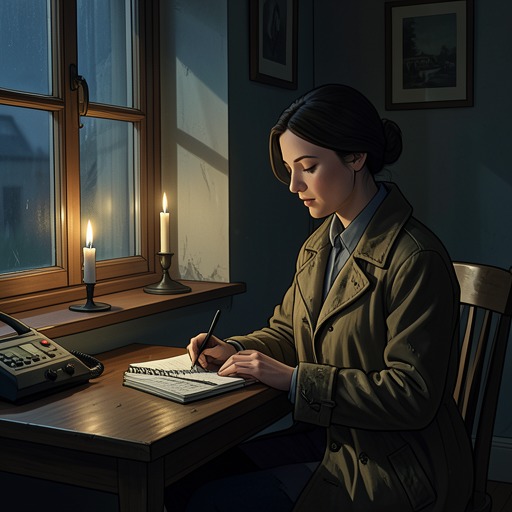
After weeks pass without a letter to Jutta, Werner writes only four lines, consisting of reassurances that he is fine and busy, then hands the note to the bunk master. The restraint is his own, not a passage visibly removed from the page. In the context of the school’s censorship, however, the brief, conventional message reads as a guarded form of communication: he knows his words pass through an institution that has already made his sister’s writing incomplete. The text does not specify whether the censor alters this particular note, so its significance lies in Werner’s limited choice of what to send, rather than in any confirmed redaction of his reply.
Significance
Censorship makes the letters a record of both connection and separation. The siblings continue to address one another, and Werner’s references to food, illness, and the people at home keep that relationship grounded in daily care. At the same time, the blacked-out passages and Werner’s four-line note expose how little of their exchange can remain fully private. The rules do not end correspondence; they shape its form, narrowing what can be known and encouraging guardedness even where no visible mark appears.
The narrative presents this control through the uneven survival of information. Werner can describe calculations, radio circuits, field exercises, and the people around him, but some details are absent by design. Jutta’s questions remain consequential even when their full wording is withheld: Werner identifies them as questions that should not be asked, and the school’s censorship makes that danger legible without disclosing their contents. Correspondence thus becomes a measure of the distance between the siblings—not merely the distance separating home from Schulpforta, but the barrier created when an institution can inspect, remove, and constrain what they say to one another.